Beyond the Login Screen: The Real-World Friendships That Started in a Fantasy World
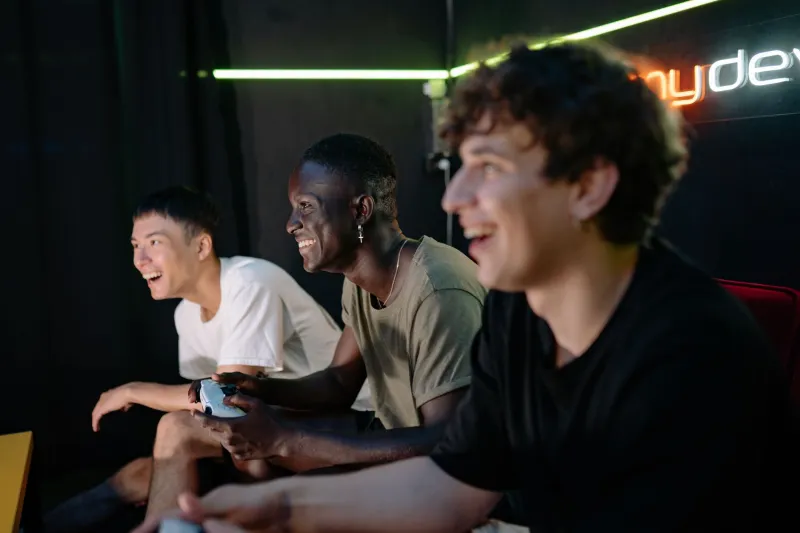
The first time Danny and Kevin talked, one of them was a level 12 rogue and the other was a healer who'd just accidentally pulled an entire dungeon room. They were strangers from opposite ends of the country — Danny from a small town in rural Ohio, Kevin from suburban Los Angeles — connected by nothing except a shared login screen and the immediate, mutual need to not die.
That was fourteen years ago. Last spring, Danny flew to California to be a groomsman at Kevin's wedding.
Stories like this don't surprise the people who live them. But they still catch the outside world off guard — the idea that the friendships formed inside a fantasy game could be as real, as durable, and as meaningful as the ones built in classrooms or neighborhoods or workplaces. Players have known for decades what researchers are only beginning to document: online RPGs are, among other things, extraordinary engines for human connection.
The Conditions That Make It Happen
It's worth asking why. Not all online spaces generate lasting friendships. Social media platforms, for all their connectivity, are notoriously shallow at the relationship level. But online RPGs — particularly the immersive, long-form, multiplayer variety — seem to produce genuine bonds at a rate that's hard to explain without looking at the structure of the experience itself.
The key ingredients are challenge, time, and interdependence.
When you spend forty hours progressing through a difficult raid with the same group of people, something happens that's difficult to manufacture artificially. You see how each person handles pressure. You learn their communication style, their humor, their frustrations. You cover for each other, call each other out, celebrate together, and occasionally want to strangle each other. It's a compressed, high-stakes social environment that mirrors — in surprisingly faithful ways — the conditions that create real-world trust.
"People always say 'it's just a game' like that means the relationships aren't real," says Monique, a 32-year-old from Atlanta who's maintained friendships from an online RPG she first played in her teens. "But the conversations we had while we were playing weren't about the game. They were about our lives. The game was just the place we kept showing up to have them."
What Server Merges Reveal
Online RPG communities face a stress test that most real-world social groups never encounter: the sudden, involuntary collision of two communities into one. Server merges — where declining player populations force administrators to consolidate multiple servers into a single one — are disorienting, often contentious events. Established social hierarchies get scrambled. Guild politics get complicated. The comfortable familiarity of a known community gets replaced, overnight, by a crowd of strangers.
And yet, the friendships that survive server merges tend to emerge stronger.
"When our server merged, we lost about half our guild because people just didn't want to deal with the transition," recalls Terrence, a 40-year-old from Houston who's been playing online RPGs since the early 2000s. "But the people who stayed? We're still talking every week. Some of us have never met in person. Some of us have visited each other multiple times. The merge was actually a filter. It showed us who actually valued the community versus who was just there for the content."
The bonds that survive disruption tend to be the ones built on something beyond the game itself — on genuine mutual investment in the people, not just the shared activity.
When the Game Dies
If server merges are a stress test, game shutdowns are the final exam. When a beloved online RPG goes offline for good — and plenty do, especially smaller or older titles — the community it housed faces an existential question: do we stay connected, or do we scatter?
For friendships with real roots, the answer is usually the former, even when it requires significant effort.
Sarah and Diane met in an online fantasy RPG that shut down in 2017. They'd been playing together for four years at that point — enough time to become genuine confidants despite the fact that they'd never been in the same room. When the shutdown was announced, they didn't wait to figure out where to go next. They created a group chat that same week.
"We've played three different games together since then, and none of them have really stuck," Sarah says. "But that almost doesn't matter anymore. The game was never really the point. We use Discord, we text, we video call. We met because of an RPG, but we're friends because of us."
Diane, who lives in Minnesota while Sarah is in Florida, adds: "We've talked about meeting up for years. Last summer we finally did it. Spent a long weekend together. It was completely natural, like we'd known each other in person our whole lives. Because in a way, we had."
The Geography of Online Belonging
One of the underrated gifts of online RPG friendships is their immunity to geography. The traditional constraints that limit real-world social circles — you have to live near someone, work near someone, move in overlapping social spheres — simply don't apply. A player in rural Montana and a player in New York City can share a guild, a raid schedule, and years of late-night conversation without ever being within a thousand miles of each other.
For players in isolated communities, or those who struggle with social anxiety, or those who've moved frequently and lost touch with local networks, this geographic freedom isn't just convenient. It's life-changing.
"I grew up in a pretty small town in West Virginia," says Marcus, 27. "There weren't a lot of people who were into the same things I was. But online, I found my people immediately. Some of my closest friends now are scattered across the country. I've visited a few of them. They've visited me. Those friendships made me feel less alone during some genuinely hard years."
What Gaming Does That Other Platforms Can't
The friendship-forging power of online RPGs isn't magic. It's design. These games create recurring, purposeful contact — the kind that psychologists identify as essential for relationship formation. You don't just encounter the same people once. You show up together, repeatedly, over months and years, working toward shared goals.
That sustained shared experience is the substrate on which real connection grows. And in a world that's increasingly fragmented, where neighbors don't know each other's names and communities feel more virtual than physical anyway, the idea that some of our most meaningful relationships might start in a fantasy world feels less strange and more like a natural adaptation.
The shadows in these games are designed to be formidable. But as it turns out, the brightest thing that can come out of them isn't a legendary drop or a server-first clear. It's a friendship that outlasts the game, the server, and every patch note ever written.
Danny and Kevin would tell you the same thing — probably while laughing about that dungeon wipe fourteen years ago, the one that started it all.