Break the Ladder: The Players Rewriting What Winning Actually Looks Like
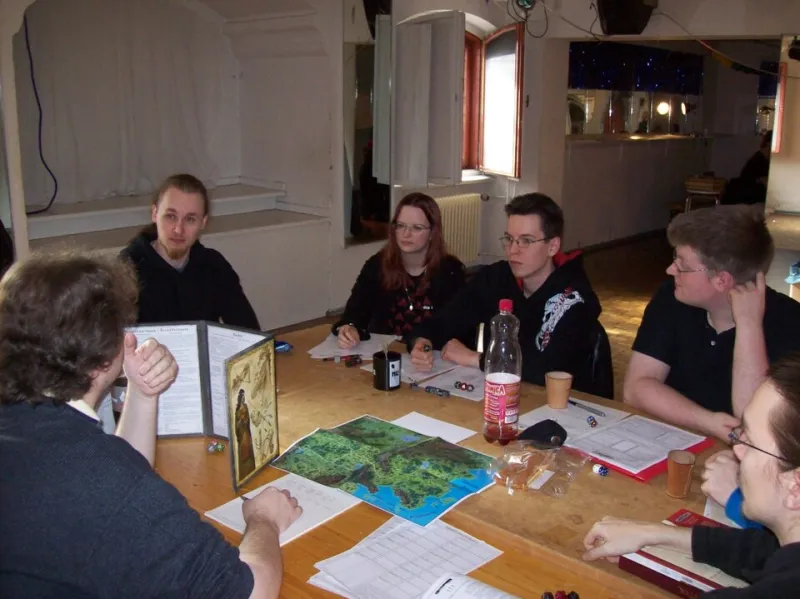
Photo: Sargoth, CC BY-SA 3.0, via Wikimedia Commons
For as long as online RPGs have existed, the path forward has been more or less the same. You grind levels. You gear up. You join a raid team. You climb the content ladder rung by rung until you've cleared everything the developers put in front of you — or until the next expansion resets the whole thing and you start over. It's a loop that's powered the genre for decades, and for a huge portion of the player base, it still works perfectly.
But something is shifting. Quietly at first, then louder, a wave of players has started asking a question that sounds almost heretical: What if we just didn't do it that way?
The Ladder Was Never Mandatory
The traditional MMO progression model is, when you strip away the familiarity, a set of suggestions. Developers build content in a rough sequence and nudge players toward it with gear requirements and level gates. But the gates are rarely absolute. And players, being the creative, stubborn, occasionally chaotic humans they are, have started noticing the gaps.
Take the growing community of what some servers are calling "horizontal runners" — players who deliberately avoid vertical progression in favor of breadth. Instead of pushing to max level and raiding, they commit to mastering every single side system the game offers: crafting economies, housing mechanics, PvP minigames, exploration achievements. They're not trying to reach the top of the mountain. They're trying to map every trail on the way up.
"I hit max level in the first week and I was bored," admits Priya, a 26-year-old player from Seattle. "So I just started doing everything else. I became one of the top crafters on my server. I built a player house that people actually come to visit. I have more fun than most of the raiders I know, and I've never set foot in a high-end dungeon."
Priya's server ranking in crafting output puts her in the top 3% of her faction. She has zero raid clears. By traditional metrics, she's nowhere. By her own metrics, she's exactly where she wants to be.
The Speedrun Mentality Invades the RPG Space
On the other end of the spectrum, a different kind of rule-breaker is making noise: the endgame speedrunner. Not to be confused with classic game speedrunning, this is something more specific — players who race through content not to post a world record, but to compress the entire intended progression arc into the shortest possible window and then pivot to self-imposed challenges.
The goal isn't to skip the experience. It's to reclaim control over the pacing.
"The game assumes you'll spend six months gearing up before you attempt certain content," explains Terrell, a 31-year-old from Atlanta who's been a fixture in his server's unconventional play community. "I did it in three weeks through hyper-optimized play, and then I went back and soloed old raid content for fun. I made my own challenge. The developers didn't design it, but it was more rewarding than anything they actually put in front of me."
This kind of self-directed endgame is proliferating across servers, with players forming loose communities around shared alternative win conditions. Some do ironman-style runs with zero deaths allowed. Others create themed character restrictions — warrior-only weapon users, pacifist builds that avoid all combat, economy-only players who never leave a city. The creativity is genuinely wild.
What This Means for Server Culture
Here's where it gets interesting from a community standpoint: these players are changing the social fabric of their servers, whether the traditional progression crowd likes it or not.
When someone becomes known as the best crafter on a server, or the player who solo-cleared a legacy raid on a wildly unconventional build, they generate a different kind of legend. Not the kind that comes with a world-first screenshot and a forum post. The kind that spreads through word of mouth, through "you have to see this" moments, through the slow accumulation of a reputation that doesn't fit into any official ranking system.
"I've seen this player on my server who does nothing but roleplay and run in-game events," says Dana, a 28-year-old from Nashville. "No raiding, no PvP rankings. But everyone knows who she is. She's been on the server longer than most guilds have existed. She is the culture of that server in a way that a world-first raider just isn't."
This soft influence — the kind that doesn't show up on leaderboards — is becoming a real form of server power, and the players who've figured that out are leveraging it in fascinating ways.
The Pushback Is Real
Let's be honest: not everyone is celebrating this shift.
There's a legitimate argument that alternative progression paths dilute the shared experience that makes online RPGs meaningful. When everyone is playing by different rules, the common language of the community — "what tier are you," "have you cleared the new raid" — starts to break down. Progression serves a social function. It gives players a way to quickly understand each other's experience level and find compatible teammates.
When someone shows up to a pickup group without traditional gear progression, even if they're a genuinely skilled player, there's friction. Trust is harder to establish. The shorthand doesn't work anymore.
"I get it," Terrell admits. "I've caused confusion in groups before because my gear doesn't look right for my skill level. You have to do more explaining. It's a real cost."
A New Definition of 'Playing the Game Right'
What's actually happening here, underneath the debate about gear scores and raid hierarchies, is a philosophical argument about what games are for.
The traditional model says games are for completing developer-intended content and measuring yourself against that content. The emerging model says games are sandboxes where the most interesting thing you can do is invent your own goals and pursue them with total commitment.
Neither of these is wrong. They're just different orientations — and for the first time in a long time, both of them are thriving simultaneously on the same servers.
The players rewriting the progression rulebook aren't anti-game. They're arguably more invested in their games than anyone else. They've thought harder about what they want out of the experience and engineered a path to get there.
In a genre built on the idea that you can become anything you want to be, maybe the most legendary move of all is deciding what 'legendary' means for yourself.